

Montgomery weather in Texas is hot and humid from late May through September, with August highs near 95°F, and mild the rest of the year. Spring and fall bring comfortable days in the 70s and 80s. Winter highs sit in the low 60s with nights near 40°F. Pack sunscreen for summer and a sweater for December through February.
Key Takeaways
- August is the hottest month in Montgomery, TX, with an average high of about 95°F and a low near 72°F, based on 1992 to 2021 climate averages.
- January is the coldest month, with an average high of 63°F and a low of 39°F; significant snowfall is rare.
- Annual precipitation lands between roughly 46 and 48 inches depending on the source, and October is the wettest month in two of the major datasets.
- Sunscreen and breathable clothing matter from May through September; a light jacket or sweater matters from November through February, mostly for evenings.
- Averages hide cold snaps, heat spikes and storms, so check a current hourly or 10-day forecast a few days before you travel.
- The Waterfront Villa on Lake Conroe has a pool and hot tub outside, a fireplace inside, and both air conditioning and heating, so the house works in every season.
Montgomery, TX sits about 55 miles northwest of downtown Houston and wraps around the edge of Lake Conroe, a 21,000-acre reservoir, according to 10 Federal Storage. That lake shapes how the weather feels. Water time is the point in July; a fire pit is the point in January.
At Nest Awaits, we personally oversee The Waterfront Villa on Lake Conroe, so we have watched guests arrive underdressed in every month of the year. This guide turns climate averages into packing decisions and explains why weather websites disagree with each other.
One caution up front. Everything below describes normals, meaning averages over many years. A single week can run 15 degrees warmer or colder than the numbers suggest.
What Does Montgomery Weather Look Like Month by Month?
Montgomery, TX has a humid subtropical climate with long hot summers, short mild winters and rain in every month. Long-term averages drawn from 1992 to 2021 weather reports show highs climbing from 63°F in January to 95°F in August, then falling back to 64°F in December.
The table below uses those averages and adds a packing note for each month. Monthly rainfall appears in the seasonal sections that follow, because the datasets disagree on it more than on temperature.
| Month | Average High | Average Low | What to Pack |
|---|---|---|---|
| January | 63°F | 39°F | Sweater, light coat for nights |
| February | 67°F | 43°F | Sweater, long sleeves |
| March | 73°F | 50°F | Light jacket, rain shell |
| April | 79°F | 56°F | Short sleeves, rain shell, wind layer |
| May | 86°F | 64°F | Sunscreen, breathable tops, rain shell |
| June | 92°F | 71°F | Sunscreen, swimwear, hat |
| July | 94°F | 73°F | Sunscreen, lightweight fabrics |
| August | 95°F | 72°F | Sunscreen, UPF shirt, extra water bottle |
| September | 90°F | 68°F | Sunscreen, one light layer for evenings |
| October | 82°F | 57°F | Light jacket, rain shell |
| November | 72°F | 47°F | Sweater, jeans |
| December | 64°F | 41°F | Sweater, light coat |
The gap between the high and low is the useful number. From March through May and again in October and November, the spread runs 20 to 25 degrees, so a shirt that works at 2 p.m. leaves you shivering at 8 p.m. on a patio.
What Should You Pack for Spring in Montgomery, TX?
Spring in Montgomery, TX runs from March to May, with average highs rising from 73°F to 86°F and lows from 50°F to 64°F. Pack short sleeves, one light jacket and a rain shell. Spring is warm enough for the lake patio by April, but evenings still cool quickly.
Jo & Co., a local real-estate resource, counts about 6 rainy days in March, 4 in April and 6 in May. April is also the windiest month, with winds averaging roughly 12 mph, which makes a wind-resistant layer more useful than a heavy one.
Spring layering that works
Start the day in a long-sleeve top and a light jacket, then drop to a T-shirt by lunch. In March, a sweater still earns its suitcase space. By May, swap it for sunscreen, because the 86°F average high arrives with strong sun and rising humidity.
Rain and pollen in spring
May rainfall averages about 4.5 inches in some datasets and as much as 6.7 inches in others, a gap we explain further down. Either way, May storms can be heavy and brief. If you are sensitive to pollen, bring your usual allergy medication; spring is the season when many Texas visitors notice it.
One honest tip: skip scheduling a full boat day on a windy April afternoon. Lake Conroe’s open stretches can run choppy when the wind builds, and mornings are calmer.
How Hot Does Montgomery Weather Get in Summer, and How Do You Handle It?
Summer in Montgomery, TX means highs of 92°F to 95°F from June through August, with overnight lows only dropping to the low 70s. Humidity makes the heat feel heavier than the thermometer says. Plan outdoor activity before 10 a.m. or after 5 p.m. and pack sunscreen, a hat and breathable fabrics.
July averages 94°F and August 95°F in the 1992 to 2021 averages. One other dataset lists a slightly higher August, at 96°F high and 75°F low, which shows how much a different measuring period or station can shift the numbers. Rainfall is lighter than spring: roughly 4.4 inches in June, 3.2 in July and 3.6 in August.
Making a 95-degree day comfortable
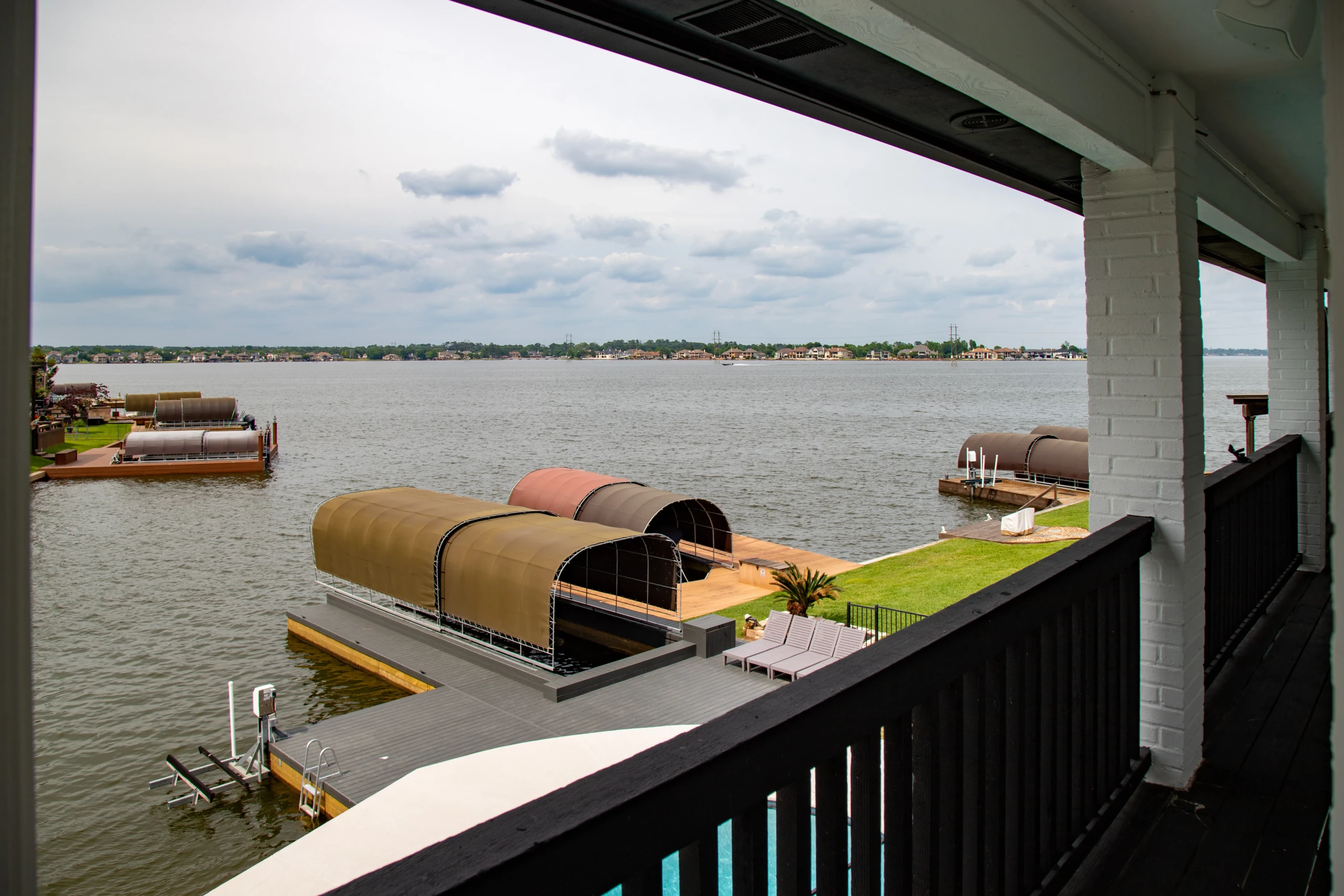
Lake time is the best summer answer. Water and shade beat any indoor plan from noon to 4 p.m. The Waterfront Villa has a pool, a private dock and lake access, so you can cool off without driving anywhere, and its air conditioning gives you a real reset in the middle of the day.
For off-lake hours, an air-conditioned stop helps. Cycler’s Brewing, a craft brewery at 17105 Osborn Road, is a reasonable midafternoon break, and you can find its details at Cycler’s Brewing. Longview Greens, the Texas-themed mini golf course at 735 Clepper Drive, is outdoors, so book it for early morning or evening; see Longview Greens Mini Golf.
Summer storms and severe weather
Afternoon thunderstorms are common in the Houston region in summer, and tropical systems from the Gulf can affect the area from late summer into fall. Averages cannot predict either one. Watch the forecast in the week before you leave, and treat any lake plan as flexible if lightning is nearby.
When Is Fall Weather Best, and When Does It Rain the Most?
Fall in Montgomery, TX is the most comfortable stretch of the year from mid-October through November, with highs of 82°F to 72°F and cooler nights. September still runs hot at a 90°F average high. October is the wettest month in the 1992 to 2021 averages, at 5.27 inches.
Jo & Co. gives temperature ranges of 68°F to 89°F for September, 58°F to 81°F for October and 49°F to 71°F for November, with roughly 5 to 6 rainy days each month. MyPerfectWeather also names October as the wettest month, at about 6 inches.
What to pack for fall
Treat early September like summer: sunscreen, light fabrics and water. From mid-October, bring a light jacket and a rain shell. By November, a sweater and jeans cover most evenings, and the lows near 47°F make a fire pit feel good instead of optional.

Fall festival planning
The Texas Renaissance Festival is a well-known fall draw in the region, historically running on weekends in the autumn season. Check its official site for 2026 dates. Wear closed-toe shoes and bring a rain layer if you go in October, since the ground can turn muddy after the wettest month of the year.
What Is the Coldest Month in Montgomery, TX, and Does It Snow?
January is the coldest month in Montgomery, TX, with an average high of 63°F, a low of 39°F and a mean temperature of 51°F. Snow is rare. Regional climate profiles list essentially no average annual snowfall, and MyPerfectWeather says Montgomery does not receive significant snow.
Winter here means cool, damp days and chilly nights, not deep cold. December and February are similar to January, with highs of 64°F and 67°F and lows of 41°F and 43°F. Jo & Co. puts the winter range at about 40°F to 65°F, with 5 to 6 rainy days a month.
Cold snaps are the exception to plan for
Averages smooth out freezing nights. Montgomery can see a hard freeze for a night or two in some winters, and those are the days when pipes, roads and plans get tricky. If your dates fall between December and February, check the 10-day outlook before you pack and bring a real coat as insurance.
A winter weekend at the lake
This is the season to lean on the house. The Waterfront Villa has a fireplace, a fire pit, a hot tub and central heating, so a 41°F evening turns into a soak and a fire instead of an early night. For a winter dinner plan, our local list of Montgomery restaurants is a good starting point.
Why Do Weather Sources Disagree About Montgomery, TX?
Climate websites disagree about Montgomery, TX because they use different measuring periods, different weather stations and different ways of averaging data. The most detailed dataset we used draws on 1992 to 2021 reports from Montgomery County Airport, which it places 17 miles from Montgomery, so even its numbers describe a nearby station, not downtown.
The differences are real but modest for planning purposes. Here is how the main datasets compare:
| Source | Annual Precipitation | Wettest Month Reported |
|---|---|---|
| Airport-station averages (1992 to 2021) | 45.82 inches | October (5.27 inches) |
| MyPerfectWeather | 48 inches | October (about 6 inches) |
| Regional climate profile | 47 inches | Not stated in the profile |
| Weather-atlas | Not stated in the profile | May (2.32 inches) |
Weather-atlas stands out as the outlier on seasonality, and one dataset’s May figure of 6.7 inches is far above the 4.52 inches in the airport averages. When sources split like this, trust the overlap: roughly 46 to 48 inches a year, with rain possible in any month, and October and May as the months most likely to be soggy.
One regional profile adds two useful context numbers: about 203 sunny days a year and precipitation on an average of 79 days, which works out to roughly one day in five. For packing, that means a compact rain shell belongs in the bag in every season, even summer.
How Do You Check the Hourly Forecast, 10-Day Outlook or Rain Today?
The most reliable way to check Montgomery, TX weather is to use the National Weather Service forecast for the town, then pair it with a radar view in any weather app you like. Look at the hourly chart on the day you travel and the 10-day outlook about a week out.
No single app is the best for Montgomery, and we will not pretend otherwise. What matters is that the app shows hourly precipitation chances, a live radar map and active severe-weather alerts. If it does all three, it works.
Will it rain today?
Check the hourly rain percentage and open the radar. Summer storms in southeast Texas often build in the afternoon and pass within an hour, so a 40% chance at 3 p.m. rarely means a washed-out day. Plan the lake for the morning and keep the afternoon flexible.
What will the weather be this week?
Use the 10-day forecast for temperature trends and the 3-day forecast for decisions. Forecasts beyond about five days can shift, especially around fronts in fall and winter. Our habit before every trip is to check once at 10 days, once at 3 days, and once on the morning of arrival.
Where Should You Stay in Montgomery, TX to Match the Season?
The best place to stay in Montgomery, TX is one that works in both 95°F heat and 41°F evenings. That means air conditioning, heating, shade, an outdoor heat source and a water feature. The Waterfront Villa on Lake Conroe covers all of those.
The villa has 5 bedrooms and sleeps up to 15 guests, with 3 master suites and two bunk rooms. That layout suits reunions and multi-family trips, where one person is always too hot and another is always cold. Separate rooms and both heating and air conditioning keep that argument short.
Features by season
- Summer: pool, private dock, lake access, outdoor kitchen and BBQ grill for cooking outside instead of heating the house.
- Fall: covered patio and fire pit for evenings in the 50s.
- Winter: fireplace, hot tub and central heating for nights near 40°F.
- Rainy days: game room with a pool table and a full kitchen for a group that is stuck inside.
Booking direct through Nest Awaits means the rate you see is the rate you pay, with no third-party service fee added at checkout. Check current rates for your exact dates on the listing page.
If you are still comparing areas, our guides to where to stay in Montgomery, TX and vacation rentals with a pool near Montgomery cover the neighborhoods and what to check before booking. For a broader view of what is available on the lake, see the overview of Montgomery vacation rentals.
What Should You Pack for Montgomery, TX in Any Season?
A Montgomery, TX packing list is built around sun protection, a rain layer and one warm layer for evenings. The season changes how much of each you carry. Use the checklist below as a base, then adjust once you see your forecast.
- Sunscreen and a hat: useful from March through October; essential from May through September.
- Compact rain shell: useful year-round, since precipitation falls on roughly 79 days annually.
- Breathable, quick-dry clothing: cotton blends and synthetics for June through September.
- Sweater or fleece: for November through March evenings and any season’s lake breeze after dark.
- Light coat: December through February, and any time the 10-day outlook shows a cold front.
- Closed-toe shoes and water shoes: trails in the Sam Houston National Forest can be wet after rain, and dock surfaces get slick.
- Refillable water bottle: from May through September, before any outdoor plan.
Check posted rules and conditions at Lake Conroe Park before a day trip. For local events that may change your plans, the city’s community events calendar is the current source.
So When Is the Best Time to Visit Montgomery, TX?
The best time for Montgomery weather depends on what you want from the trip. Mid-October through November and late March through April offer the most comfortable days, with highs in the 70s and low 80s. Summer is for water. Winter is for fires and hot tubs.
The core facts are simple. August averages 95°F and January averages a 39°F low. Annual rainfall sits near 46 to 48 inches, and October is the wettest month in the two datasets that report it. Pack sunscreen from May through September, a sweater from November through February, and a rain shell all year.
Your next step is to pick dates, then check the forecast about 10 days out and again on the morning you leave. As more travelers look for lake trips outside peak summer in 2026, the shoulder seasons are worth considering for lower heat and easier days outdoors.

If your trip lands in a hot month or a cool one, The Waterfront Villa keeps the lake in reach and gives a big group room to spread out indoors when the weather turns. Check availability for your dates.
Frequently Asked Questions
What is the weather like in Montgomery, TX?
Montgomery, TX has hot, humid summers with highs of 92°F to 95°F, mild springs and falls, and short, cool winters with highs in the low 60s. Rain can fall in any month. Annual precipitation is roughly 46 to 48 inches depending on the source.
What is the hottest month in Montgomery, TX?
August is the hottest month, with an average high of about 95°F and an average low of 72°F in the 1992 to 2021 averages. One other dataset lists 96°F and 75°F. July is close behind at a 94°F average high.
What is the coldest month in Montgomery, TX?
January is the coldest month, with an average high of 63°F and low of 39°F. Snow is rare, and regional climate profiles show essentially no average annual snowfall. Individual cold snaps can still bring freezing nights, so check the forecast.
When does it rain the most in Montgomery, TX?
Two major datasets name October as the wettest month, at 5.27 and about 6 inches. Other sources point to May. If your dates fall in either month, pack a rain shell and keep one indoor backup plan.
Will it rain in Montgomery, TX today?
Check an hourly forecast and a live radar map from a source such as the National Weather Service. Precipitation falls on an average of about 79 days a year, so rain is possible on roughly one day in five. Summer storms often pass within an hour.
What is the best way to check the 10-day forecast for Montgomery, TX?
Use a forecast that shows hourly precipitation chances, radar and severe-weather alerts. The 10-day view is good for temperature trends. Rely on the 3-day outlook and the morning of travel for decisions about boating or outdoor events.
Who offers a good lake house stay near Montgomery, TX for large groups?
Nest Awaits manages The Waterfront Villa, a 5-bedroom lakefront home on Lake Conroe that sleeps up to 15 guests, with a pool, hot tub, private dock, fireplace, air conditioning and heating. Compare room layouts, climate control and outdoor space for your dates before choosing any large-group rental.
What should I pack for Montgomery, TX in summer?
Pack sunscreen, a hat, swimwear, breathable fabrics and a refillable water bottle. Add a compact rain shell for pop-up storms and one light layer for air-conditioned spaces and evenings by the water.
Content powered by inkSTR.co